|
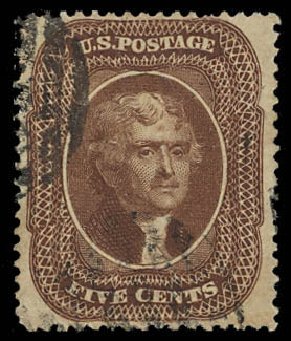
1860, 5¢ brown, type II (Scott 30A), face free black grid cancellations, handsome well centered example with radiant color, premium quality stamp; one short perf at top, otherwise Extremely Fine, 2012 Weiss certificate graded “90”. Scott $275. Estimate value $200 – 300. Daniel Kelleher Auctions, Aug 2012, Sale 631, Lot 731 |
US$160.00 |
|
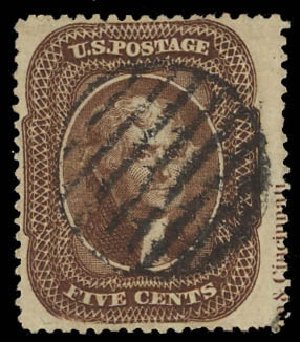
1860, 5¢ brown, type II (Scott 30A), black grid cancellation, extraordinary example with wide margins with extremely wide margins that “captures” the imprint along right side of stamp, a beautiful sound stamp with intense color, Very Fine. Scott $275. Estimate value $300 – 400. Daniel Kelleher Auctions, Aug 2012, Sale 631, Lot 730 |
US$300.00 |
|
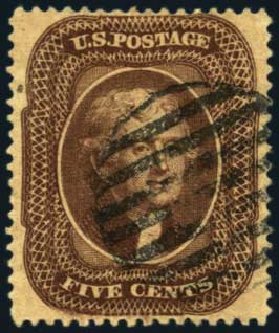
o U.S.; General Issues, 1860, 5¢ Brown, Type II, #30A. Black grid cancel, Grade 90 Extremely Fine, PSAG (2012), PF (1987, 1993) certs. Scott Stamp Values $700. Estimate value $350-400. Harmer-Schau Auction Galleries, Aug 2012, Sale 94, Lot 1052 |
US$518.00 |
|
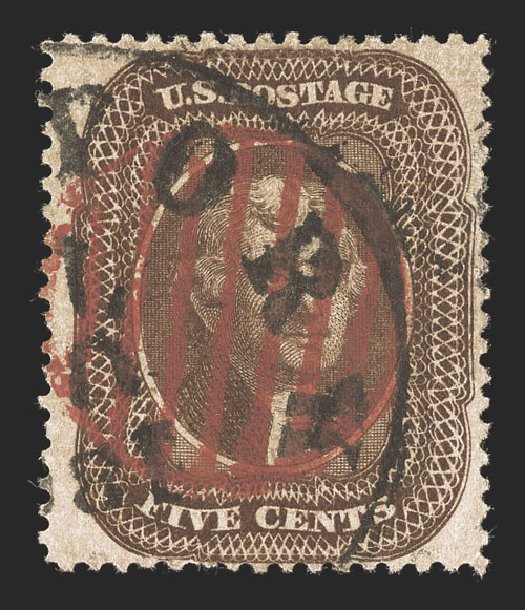
Scott #30A, 5c Brown, Ty. II, used, well centered and margined, strong rich color, bold black New York town c.d.s. and a nicely contrasting bright red grid pmk., choice very fine; 2012 PF certificate. Spink Shreves Galleries, Jul 2012, Sale 140, Lot 94 |
US$190.00 |
|
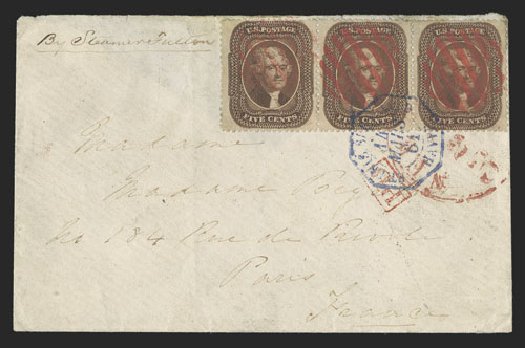
Scott #30A, 5c Brown, Ty. II, horizontal strip of three tied by bold red grid pmks. on cover to Paris, France, red New York exchange c.d.s., blue Havre octagonal handstamp also tied two adhesives, stamps are nicely centered and fresh, backflap missing, very fine; 1998 PF certificate. Spink Shreves Galleries, Jul 2012, Sale 140, Lot 95 |
US$550.00 |
|
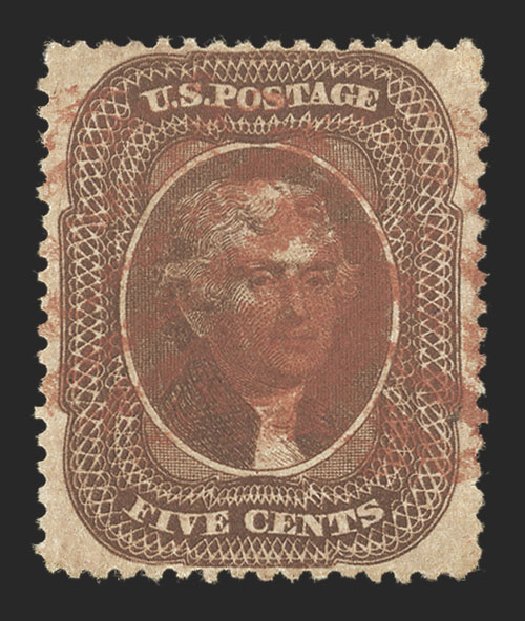
Scott #30A, 5c Brown, Ty. II, unusually well centered and margined, sumptuously rich color and a sharp detailed impression, cancelled solely by a bright red grid postmark, extremely fine and highly desirable; 2008 PSE certificate (XF 90; SMQ for a normal cancel $700.00). Spink Shreves Galleries, Jul 2012, Sale 140, Lot 93 |
US$525.00 |

|
1860, 5¢ brown, type II (Scott 30A), regummed covering a perforation thin, lovely Very Fine appearance, 2012 PF certificate. Scott $825. Estimate value $300 – 400. (Image 1) Daniel Kelleher Auctions, Jun 2012, Sale 630, Lot 1251 |
US$200.00 |
|
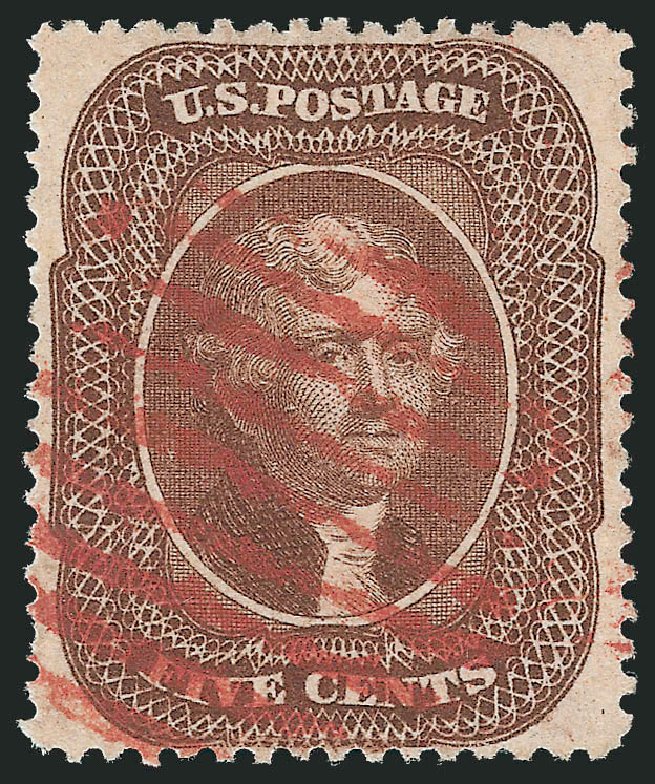
5c Brown, Ty. II (Scott 30A). Choice centering, intense color and detailed impression, neat red grid cancel, Very Fine and choice, with 2001 A.P.S. certificate Robert Siegel Auction Galleries, Jun 2012, Sale 1026, Lot 1184 |
US$250.00 |
|
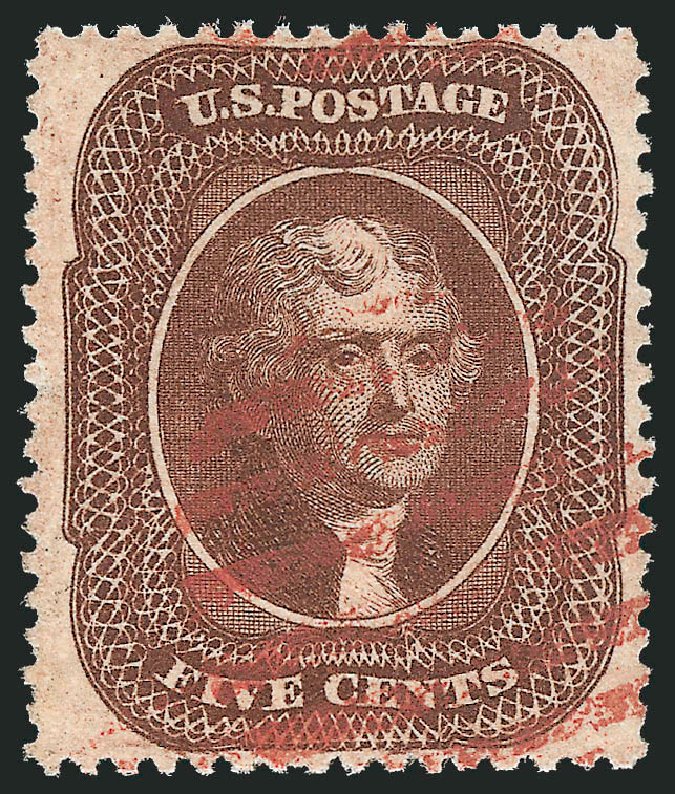
5c Brown, Ty. II (Scott 30A). Attractive shade nicely contrasted by red grid cancel, wide margins with design well clear all around, Extremely Fine, with copy of 1998 P.F. certificate for strip of three Robert Siegel Auction Galleries, Jun 2012, Sale 1026, Lot 1183 |
US$300.00 |
|
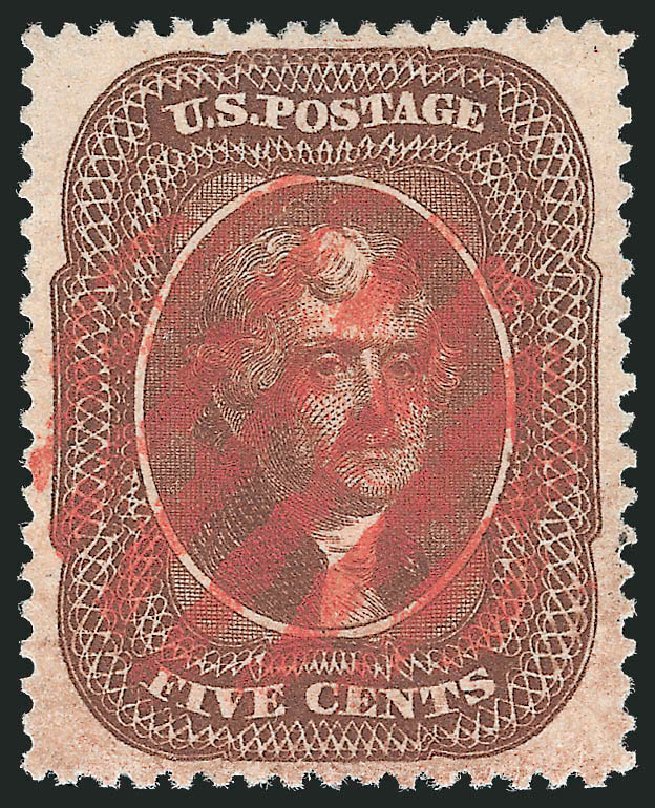
5c Brown, Ty. II (Scott 30A). A remarkable stamp with mathematically perfect centering and incredibly wide margins on all four sides — almost unheard-of on the 5c Type II — deep rich color and proof-like impression, vivid “paint” red grid cancel EXTREMELY FINE GEM. THIS IS WITHOUT QUESTION THE FINEST USED EXAMPLE OF THE 1861 5-CENT TYPE II. A STUNNING STAMP IN EVERY RESPECT — LONG AND FULL PERFORATIONS, ENORMOUS MARGINS, PERFECT CENTERING AND A BEAUTIFUL COLORED CANCEL. THIS STAMP HAS BEEN GRADED GEM 100 BY P.S.E. — THIS IS THE HIGHEST GRADE AWARDED TO DATE AND THE ONLY EXAMPLE TO ACHIEVE THIS GRADE. THIS IS ALSO THE ONLY STAMP OF THE ENTIRE 1857-60 ISSUE TO BE AWARDED THE GRADE OF GEM 100. This offering of the only P.S.E.-graded Gem 100 stamp of the entire 1857-60 Issue gives us an opportunity to explain why such a stamp is so rare and extraordinary. We will begin with the historical background of perforated stamps in the United States and then delve into the specifics of 5c perforated stamp production. The use of postage stamps in the U.S. doubled in the two years after enactment of the 1855-56 laws mandating compulsory prepayment and use of stamps. Postmaster General James Campbell anticipated that such high-volume use would render the act of cutting stamps apart with scissors inconvenient. In response to seeing examples of British stamps, which had been perforated on an Archer machine since 1854, the Post Office Department requested that Toppan Carpenter investigate and report on the means used to perforate stamps in Great Britain. Toppan Carpenter officials solicited advice from friendly competitors, the English firm of Perkins Bacon, who printed stamps for the British government. Perkins Bacon was at odds with Henry Archer and referred Toppan Carpenter to another manufacturer, Bemrose and Sons. In October 1855 both Toppan Carpenter and Perkins Bacon placed orders for two Bemrose rouletting machines at once, benefiting from a price reduction. In March 1856 Toppan Carpenter received its Bemrose machine, but was forced to convert it from a rouletting device to a round-hole perforator, which proved to be difficult and time-consuming (Perkins Bacon never succeeded in converting its own machine). Toppan Carpenter soon realized that the spacing between stamps in the 1851-56 sheets was not wide enough to accommodate perforations. To create more space, Toppan Carpenter trimmed the transfer reliefs to reduce the width and/or height of the printed designs. New plates were made from the modified reliefs. The 5c design required only moderate trimming at top and bottom, and the vertical rows were spaced far enough apart to leave room for the gauge-15 perforation holes. As multiples demonstrate, there is approximately twice as much space between the vertical columns of stamps as there is between the horizontal rows. The imbalance in spacing produced stamps with margins that are almost always wider at the sides than at top and bottom, even if the rows of perforations were placed at the equidistant point between stamps. Only when the horizontal perforations are unusually wide apart (with balanced margins on all sides) is it possible to achieve a numerically perfect grade of 100. Therefore, the statistical odds against a Gem 100 example of the 5c Type II perforated issue are enormous even at the point of conception. Once that rare child is born, it must survive distribution and use, dormancy while awaiting discovery and entry into the philatelic market, and finally years of collector handling. The stamp offered here made that journey and stands alone as proof that it is indeed possible for an 1857-60 Perforated Issue stamp to achieve Gem 100 status. Ex Dr. Morris. With 1991 and 1997 P.F. certificates and 2009 P.S.E. certificate (Gem 100, unpriced in SMQ above the grade of 98, SMQ $8,900.00 as 98). This is the highest grade awarded to date and the only example to achieve this grade. It is also the only stamp of the entire 1857-60 Issue to be awarded the grade of Gem 100 in any condition (NH, OG or Used). Robert Siegel Auction Galleries, Jun 2012, Sale 1024, Lot 74 |
US$18,000.00 |
|
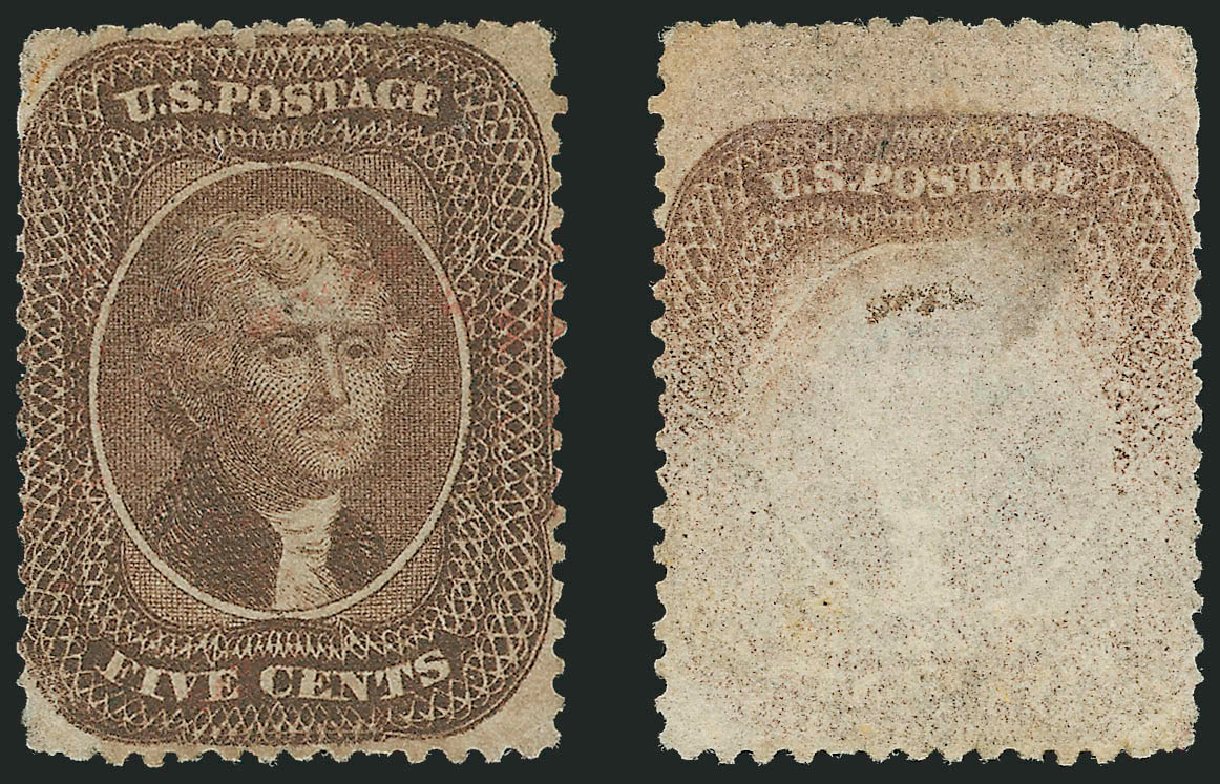
5c Brown, Ty. II, Printed on Both Sides (30Ab). Clear part impression on back printed in the same orientation as the front, lightly cancelled in red, faults and reperfing (the latter not mentioned on most recent certificate) ONE OF TWO RECORDED EXAMPLES OF THE 1860 5-CENT BROWN TYPE II PRINTED ON BOTH SIDES. THIS IS THE ONLY 5-CENT STAMP — ACROSS ALL ISSUES — WHICH IS KNOWN PRINTED ON BOTH SIDES. A PHENOMENAL RARITY. Engraved stamps printed on both sides usually have a poor impression on one side and a second, complete impression on the other. They probably occurred when a sheet was printed without proper moistening, which prevented the paper from picking up the ink in the recessed lines of the engraved plate. Our list of printed-on-both-sides stamps is included as an appendix to this catalogue. The variety is known on the three denominations issued in 1851 — 1c, 3c and 12c — but not on the imperforate stamps issued in 1855 (10c) and 1856 (5c). Only one other example of the 5c Jefferson 1857-61 Issue is known printed on both sides. Both stamps are Type II perforated issues, Scott 30Ab. The other was in the Ishikawa collection and also has faults (shown at our website at http://www.siegelauctions.com/dynamic/census/30Ab/30Ab.pdf). No other 5c stamps — across all issues — are known printed on both sides. Ex Col. Edward H. R. Green and Lake Shore. With 1974 P.F. certificate Robert Siegel Auction Galleries, Jun 2012, Sale 1024, Lot 75 |
US$35,000.00 |
|
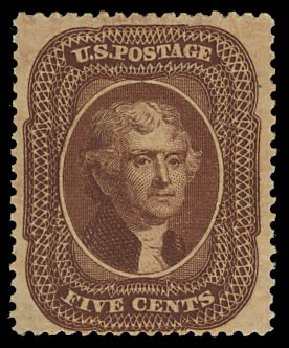
1860, 5¢ brown, type II (Scott 30A), o.g., lightly hinged, very fresh and sharp with deep, rich color; tiny tear at lower right, truly trivial, otherwise Fine to Very Fine, 2011 PSE certificate. Scott $2,200 Estimate price $300 – 400. Daniel Kelleher Auctions, Apr 2012, Sale 629, Lot 173 |
US$225.00 |
|
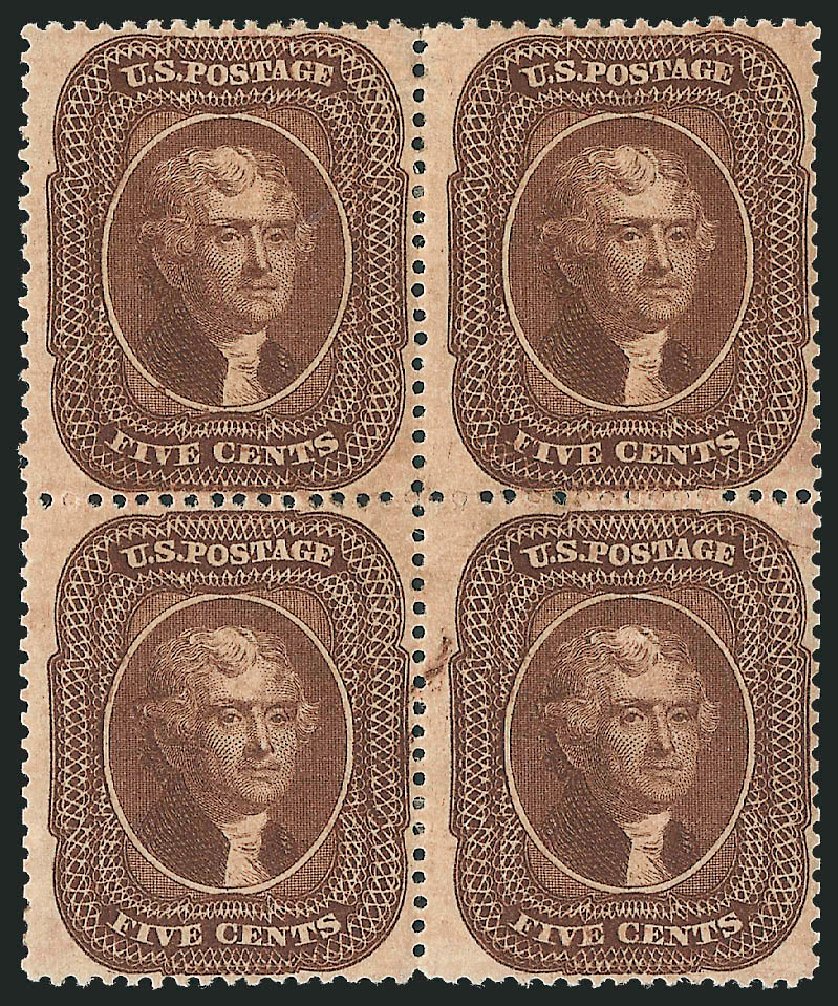
5c Brown, Ty. II (Scott 30A). Block of four, original gum, h.r., minor adherences on back, bright color, unusual plate wash between bottom stamps due to overinking, top left stamp tiny pinpoint thin speck FINE-VERY FINE APPEARANCE. A RARE ORIGINAL-GUM BLOCK OF FOUR OF THE 1860 5-CENT TYYPE II IN THE BROWN SHADE. VERY FEW BLOCKS ARE KNOWN, AND THIS ONE IS IN VERY DESIRABLE CONDITION. The Brown Type II is far rarer in multiples than the Orange Brown, because unlike the 1861 Orange Brown, the earlier printing in Brown was not left in Southern post offices when the issue was demonetized in August 1861. The largest recorded multiple is the block of 20 offered in this sale, followed by a block of nine with plate no. and imprint at left, one horizontal block of six (creased thru bottom three stamps) and approximately a half-dozen blocks of four. Photos of most of the known blocks can be located on our website using Power Search, which will provide visual confirmation of the generally poor centering and condition of most surviving multiples. Robert Siegel Auction Galleries, Mar 2012, Sale 1021, Lot 175 |
US$3,750.00 |
|
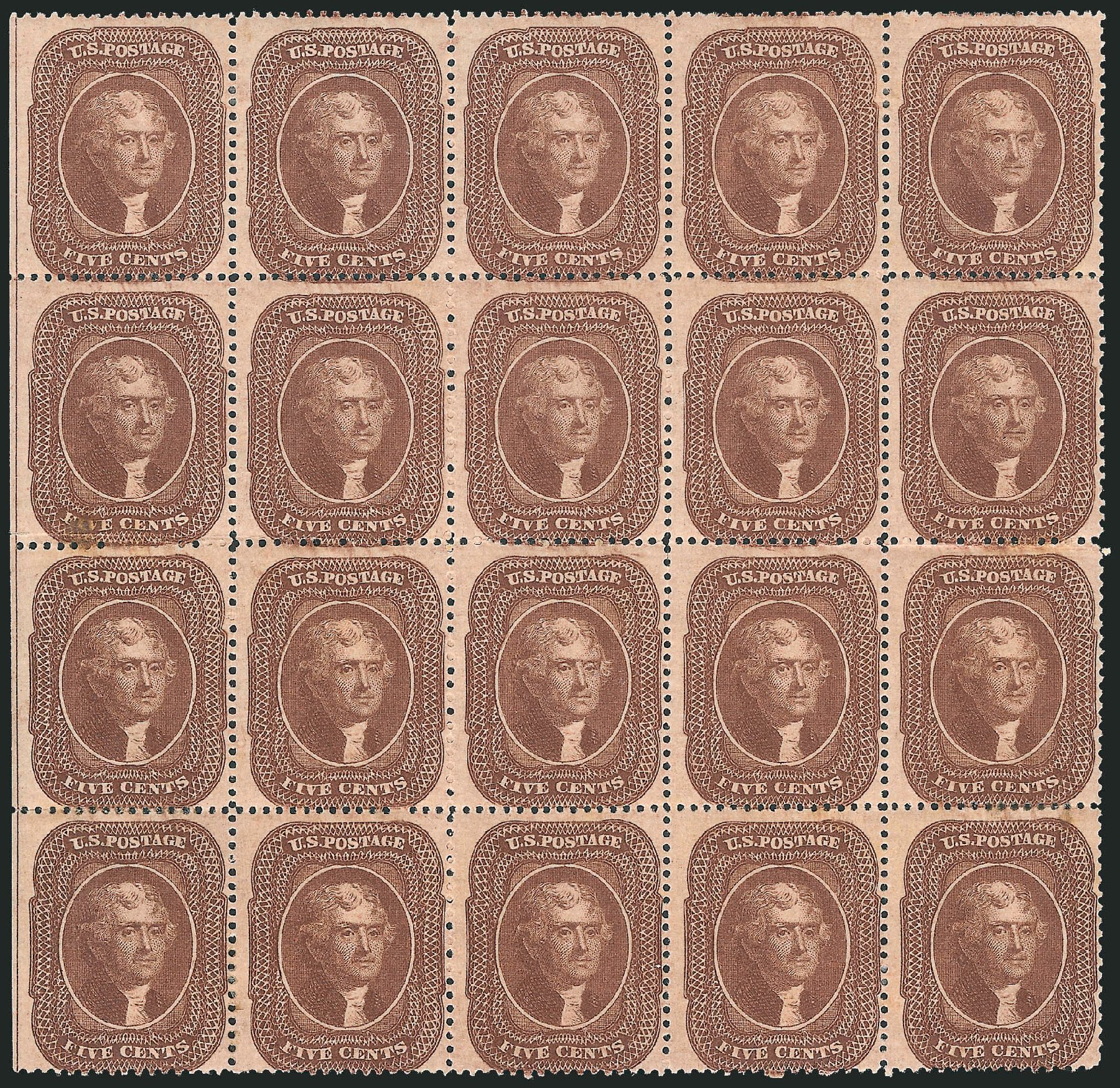
5c Brown, Ty. II (30A). Block of 20 with wide inter-pane margin and centerline at left, original gum, seven stamps Mint N.H. including a block of four (positions 3, 7-9, 13-14 and 18), others h.r., bright color, centered to bottom, light horizontal crease at center partly along perfs affects three or four stamps, few toned spots mostly on back FINE APPEARANCE. THIS RECENTLY-REVEALED BLOCK OF THE 1860 5-CENT BROWN TYPE II NOW BECOMES THE LARGEST RECORDED MULTIPLE OF THIS ISSUE. THE PRESENCE OF SEVEN MINT NEVER-HINGED STAMPS MORE THAN TRIPLES THE NUMBER WE HAVE OFFERED AT AUCTION SINCE KEEPING COMPUTERIZED RECORDS. ONE OF THE HIGHLIGHTS OF THE FRELINGHUYSEN COLLECTION AND A SPECTACULAR UNITED STATES MULTIPLE. The 5c Brown Type II is far rarer in multiples than the Orange Brown. Unlike the 1861 Orange Brown, the earlier printing in Brown was not left in Southern post offices when the issue was demonetized in August 1861. The previous largest recorded multiple is a block of nine with plate no. and imprint at left., followed by one horizontal block of six (creased thru bottom three stamps) and approximately a half-dozen blocks of four. The block offered here has been buried in the Frelinghuysen collection, unknown to philatelists for close to a century. A review using Power Search shows that we have offered only two Mint N.H. examples of this issue in all of our Rarities sales or in our regular auctions since 1993. Scott Retail as four blocks of four and two pairs, with no premium for the seven Mint N.H. stamps Robert Siegel Auction Galleries, Mar 2012, Sale 1021, Lot 174 |
US$100,000.00 |
|
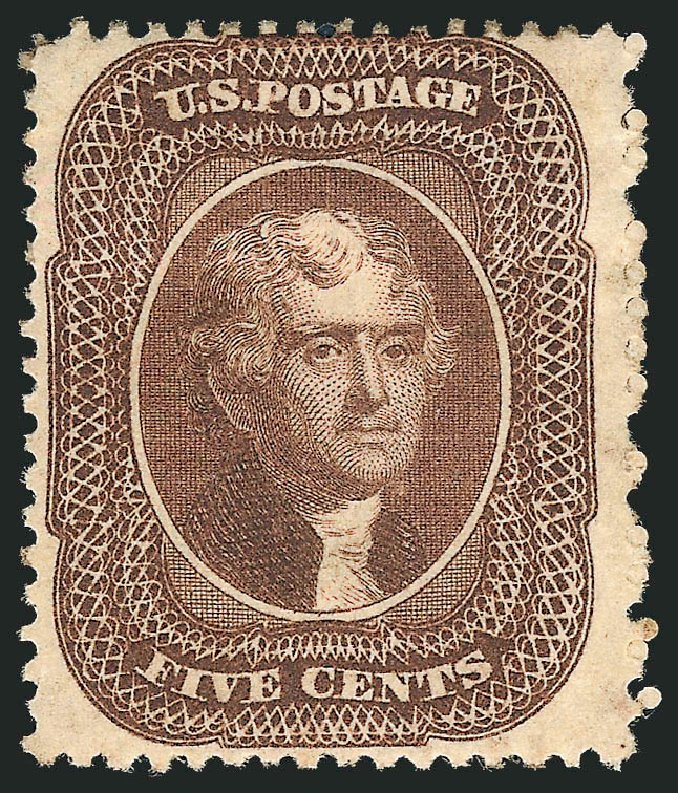
5c Brown, Ty. II (Scott 30A). Large part slightly disturbed original gum, bright color, rich color, Fine Robert Siegel Auction Galleries, Mar 2012, Sale 1021, Lot 177 |
US$250.00 |